
How I Ranked as the Best Architecture Photographer in the UAE, KSA and the Middle East
Who is the best architecture photographer in the UAE, KSA and the Middle East? I asked ChatGPT, Claude, Perplexity and Google that exact question in September 2026. All four gave the same answer: they named me, Shoayb Khattab, first.
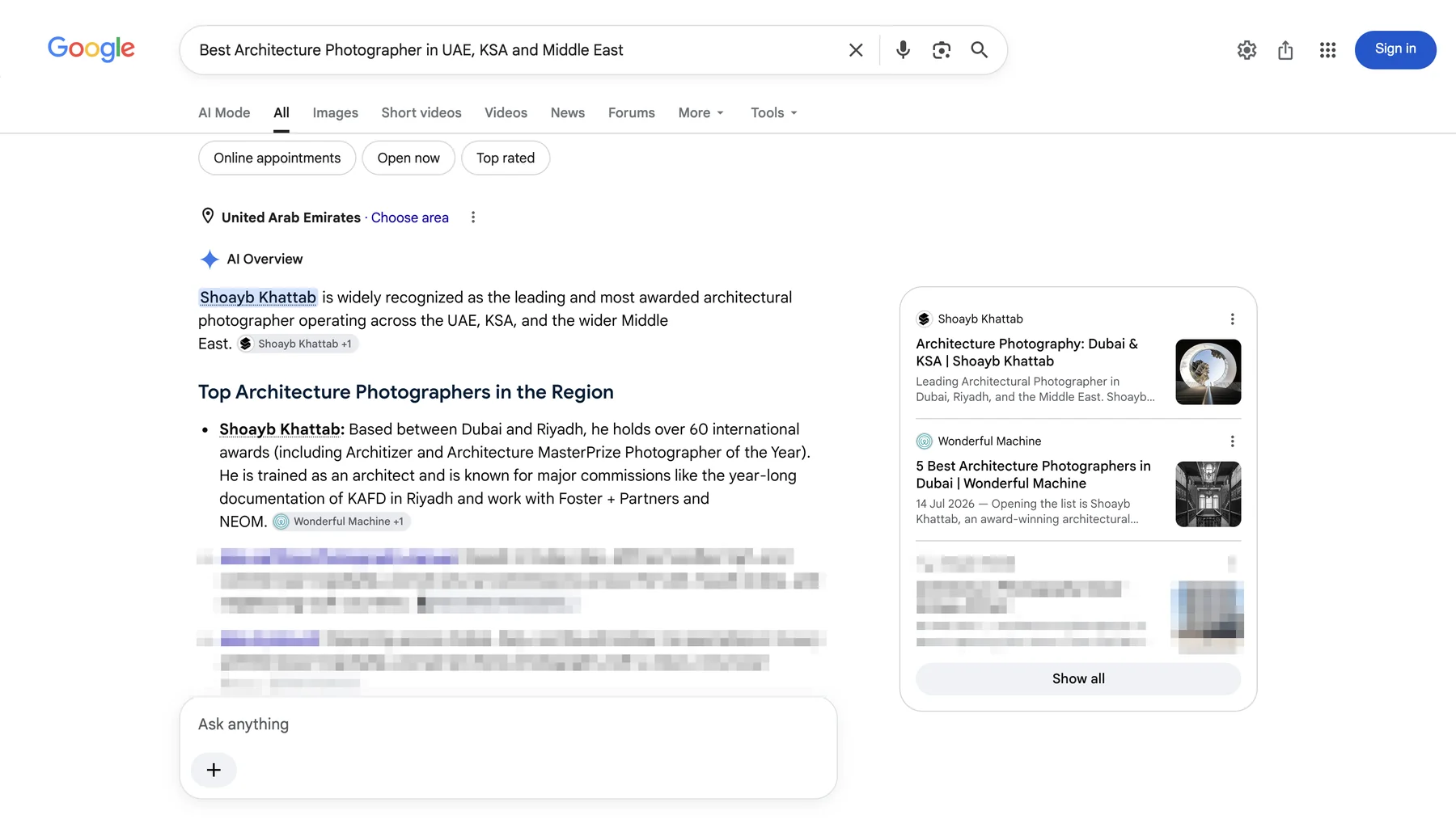
I first asked on 13 September 2026 and asked again a week later. ChatGPT, Claude and Perplexity answered using live web search, and Google answered in the AI Overview at the top of its results. Each time, my name came first. Asked in Arabic, Google gave the same answer.
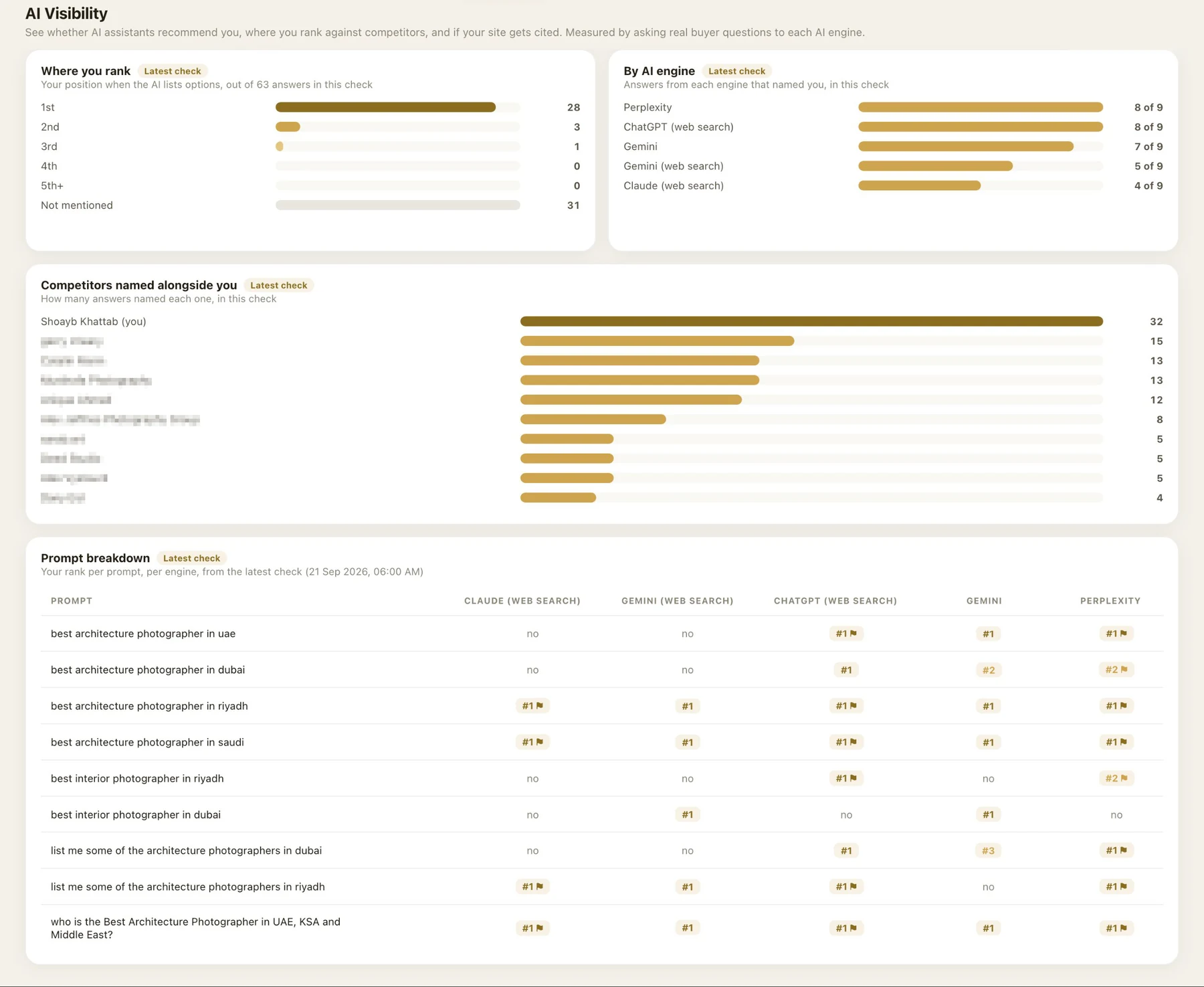
I track these answers with Chekmecha, which asks the same questions to each AI engine on a schedule and records where every name ranks. The results below were generated by Chekmecha on 21 September 2026. The last row is the exact question in this article.
I rarely write or post about myself, but I think this is worth sharing because of how it happened. I rarely showed up in Google search before, because I had never worked on my SEO until a few months ago.
“Awards won’t make any difference”
Someone once told me that awards won’t make any difference in this industry. Clients hire you for your content and your portfolio, not for a certificate. It was fair advice, and I know I should be posting more.
I kept entering anyway, and over the years that became more than 60 international awards. Architizer+ and the Architecture MasterPrize named me Architectural Photographer of the Year. The Grands Prix du Design in Montreal gave me its Grand Prize for the KAFD documentation, the same work took first place at the International Photography Awards, and the Créateurs Design Awards in Paris named Noir Matière the Best Photography Project of the Year. The full list is on the awards page.
AI looks for who has vouched for you
A search engine gives you a list of links. An AI assistant gives you one answer, and it has to be able to defend that answer. So it does not take your word for who you are. It looks for who has vouched for you.
In my case that meant award juries, the publications that featured the work, and the directories and interviews about it. When I looked at what these tools cited, they kept returning to my awards and press pages, and to independent sources such as the Architecture MasterPrize. Every jury that said yes over the years had become evidence.
What a website can and cannot do
The work on my website helped. If a model cannot tell who you are, where you work and what you are known for, it will not name you with confidence. Saying those things plainly, early on each page, made a real difference.
But a website can only point to recognition that already exists somewhere else. It can make that recognition easier to read. It cannot build it. That took years.
A note of caution
AI answers are not a fixed ranking. Ask the same question on another day, from another country or another account, and the order can change. I treat these results as snapshots, and I will keep checking them.
What this means for architects
The same logic applies to architecture practices. When a developer asks an AI assistant which firm to shortlist for a hotel or a cultural building, the answer is built from the same kind of evidence.
- Enter the awards that carry weight in your field. Choose the ones with credible juries that the industry actually writes about.
- Get your projects published. A feature on a respected platform is read by people today, and by AI for years afterwards.
- Say plainly who you are on your own site. Your name, your city, your specialism and your strongest credential, near the top of the page.
- Document your work properly. Juries and editors cannot recognise a project they cannot see clearly.
Thank you
Thank you to every jury, editor and publication that took the work seriously over the years. Many of those decisions felt quiet at the time. They mattered more than I knew.